Although we are surrounded by success stories and examples of people who have reached the top, we often encounter internal barriers, such as a lack of motivation, or external ones, such as the inaccessibility of successful...
Learning from the Best: A Success Secret or An Evolutionary Instinct?
If you’ve ever explored personal development, you’ve likely encountered one core principle: learn from those who have already achieved success. The idea is simple and intuitive—so intuitive, in fact, that evolutionary science suggests it’s something humans are naturally inclined to do.
Yet, despite its apparent effectiveness, both personal development experts and evolutionary scientists agree on one surprising truth: this strategy is underused.
In this post, I’ll explore how personal development gurus and the evolutionary science of social learning each approach the idea of learning from the best. Then, in my next post, I’ll dive deeper into why—despite its clear benefits—we often fail to fully embrace this powerful strategy.
Learning from the Best According to Personal Development
The belief that success leaves clues is a foundational idea in personal development. The premise is straightforward: study the habits, mindsets, and strategies of high achievers, and you’ll set yourself on the path to replicating their success.
This principle is at the heart of many bestselling self-help books, including Think and Grow Rich by Napoleon Hill, Rich Dad Poor Dad by Robert Kiyosaki, and The 7 Habits of Highly Effective People by Stephen R. Covey.
Experts reinforce this idea time and again. Brian Tracy, in Eat That Frog, advises:
“Find out what other successful people do and do the same things until you get the same results.”
Similarly, Robert Kiyosaki states:
“If you want to go somewhere, it is best to find someone who has already been there.” [1]
Successful entrepreneurs also credit their achievements to learning from others. In The $100 Startup, Chris Guillebeau describes how he “reverse-engineered” success by analysing what worked for others.
Likewise, Fraser Doherty, in 48-Hour Startup, explains how a seasoned entrepreneur’s advice helped him break into major supermarkets with his SuperJam brand.
The advice seems like pure common sense—so straightforward that it hardly seems necessary to read about it to put it into practice. But here’s where it gets interesting
Is Learning from the Best Just Human Nature?
The advice to learn from the successful, as promoted by personal development experts, aligns with what the evolutionary science of social learning predicts people naturally tend to do.
This prediction is rooted in Darwin’s theory of evolution by natural selection. The logic is as follows: once our ancestors developed the ability to learn effectively from others, there was strong evolutionary pressure to seek out and imitate individuals with above-average knowledge and skills. Why? Because doing so increased their chances of survival and reproduction—the fundamental drivers of biological evolution.
Since successful individuals generally possess superior knowledge and skills, those who copied them had a survival advantage over those who didn’t. As a result, modern humans are more likely to be the descendants of individuals who had an innate tendency to learn from the successful, rather than those who ignored this strategy.
However, there’s another possibility: the tendency to learn from the successful may not be purely genetic but rather a learned behaviour shaped through social interaction. If people realize that imitating high achievers consistently leads to rewards, they may develop this habit through associative learning. Alternatively, they might use metacognitive skills to recognize that modelling the most successful individuals within their field is the most effective way to improve.
Regardless of whether this tendency is instinctive or acquired, the core idea remains the same: learning from the best is a deeply ingrained human strategy.
But do we actually follow this principle in practice?
The Scientific Evidence of Learning from the Best
Experiments suggest that while we naturally lean toward learning from the successful, we don’t do it nearly as much as we should.
Take, for example, a fascinating study where participants played a computer-based hunting game, designing virtual arrowheads to maximize their success in simulated hunts.
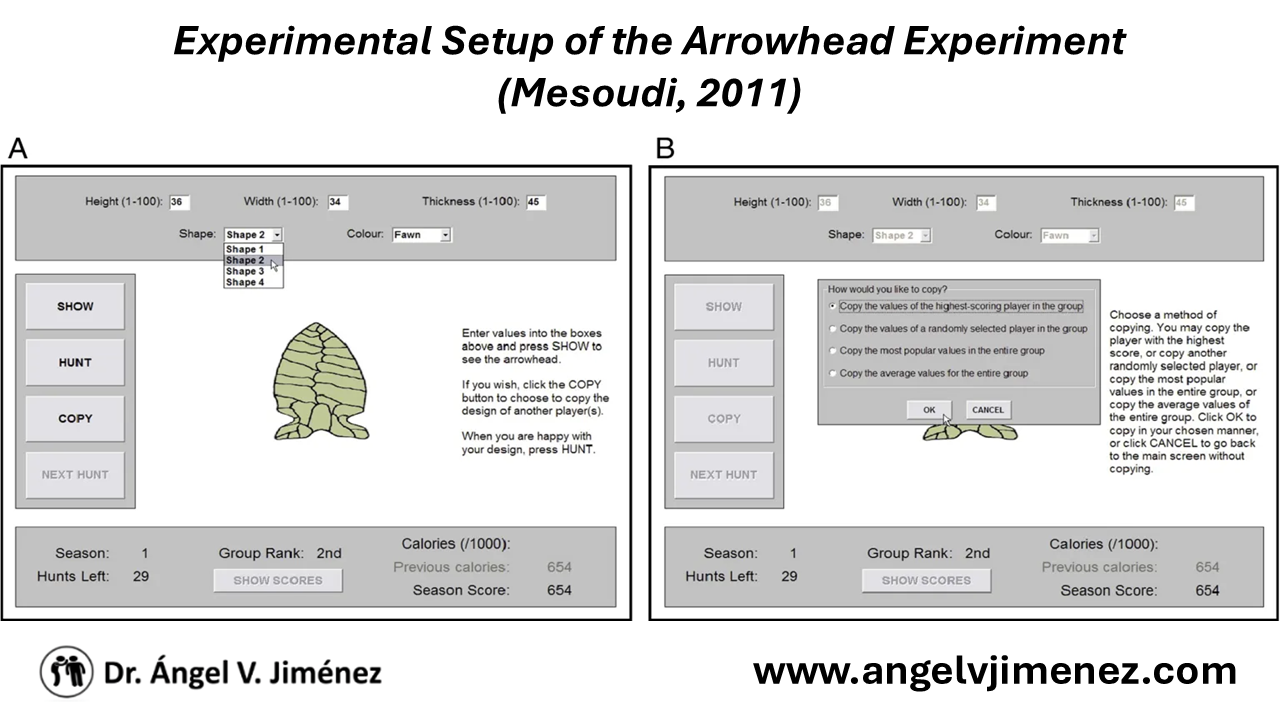
They could choose to:
- Copy the designs of the most successful player
- Copy a random player’s design
- Copy the most popular design
- Copy an average design from the group
The results showed that learning from the most successful player was the most widely used strategy. It also demonstrated that doing so was beneficial for the learners: the greater the use of this strategy, the greater the success of the participants in the experimental task.
However, here’s the twist: the results were driven by a minority of participants who systematically learned from the best. Curiously, they were also the best at individual learning, which suggests that they were good at integrating information from their own experiences with information from external sources.
Advantageous but Underused
At first glance, there seemed to be a contradiction between personal development advice and cultural evolutionary theory— personal development gurus were recommended what people seemed naturally tend to do.
However, after examining the scientific literature, the picture becomes clearer: learning from the best is undeniably beneficial, yet significantly underutilized.
This underuse is evident both in controlled experiments, as cultural evolutionists document, and in everyday life, as personal development experts emphasize.
But herein lies a tremendous opportunity. By improving the way we learn from the best, we can gain a significant edge in an increasingly competitive world.
Which brings us to a crucial question:
? Why do people learn from the successful less than they should?
I’ll be exploring that mystery in my next post. Stay tuned! ?
Dr. Ángel V. Jiménez
About the Author
Ángel V. Jiménez is passionate about intentional living, scientific psychology, and understanding human behaviour from an evolutionary perspective. He earned his PhD at the University of Exeter (UK), where he studied status acquisition and interpersonal influence, with a particular focus on the role of prestige in social learning. He subsequently conducted postdoctoral research at Brunel University London and the University of Exeter. He currently teaches research methods in psychology and lives in Prague, Czech Republic.
Through this website, Ángel shares practical, research-informed, and reflective content to help people think critically about advice, understand themselves better, and move beyond one-size-fits-all solutions. He aims to help individuals use psychological science to discover what works for them and develop their own evidence-informed approaches to living well.
References & Resources
Books
Covey, S.R. (2004). The 7 Habits of Highly Effective People. Free Press.
Doherty, F. (2016). 48-hour startup. From idea to launch in 1 weekend. Thorsons.
Guillebeau, C. (2012). $100 Startup. Pan MacMillian.
Henrich, J. (2015). The Secret of Our Success. How Culture is Driving Human Evolution, Domesticating our Species, and Making us Smarter. Princeton University Press.
Heyes. C. (2018). Cognitive Gadgets. The Cultural Evolution of Thinking. Harvard University Press.
Hill, N. (2005). Think and Grow Rich. Deckle Edge.
Kiyosaki, R. (2011). Rich Dad Poor Dad. Plata Publishing.
Mesoudi, A. (2011). Cultural Evolution. How Darwinian Theory Can Explain Human Culture and Synthesize the Social Sciences. University of Chicago Press.
Tracy, B. (2017). Eat that Frog. 21 Great Ways to Stop Procrastinating and Get More Done in Less Time. Berrett-Koehler Publishers
Blog Posts
Harapa (2021). What is metacognition? Harappa.
Jiménez, Á.V. (2025). Social Learning: How to Select Your Learning Sources. Dr Ángel V. Jiménez
Jiménez, Á.V. (2025). Why People Don’t Learn Enough from the Successful. Dr Ángel V. Jiménez
Twinkl. What is associative learning? Twinkl.
Scientific Papers
Atkisson, C., O’Brien, M.J., & Mesoudi, A. (2012). Adult Learners in a Novel Environment Use Prestige-Biased Social Learning, Evolutionary Psychology, 10(3), 519-537
Brand, C.O., Heap, S., Morgan, T.J.H. & Mesoudi, A. (2020). The emergence and adaptive use of prestige in an online social learning task. Scientific Reports, 10, 12095
Henrich, Joseph, and Francisco Gil-White (2001). The Evolution of Prestige: Freely Conferred Deference As a Mechanism for Enhancing the Benefits of Cultural Transmission. Evolution and Human Behavior 22, no. 3: 165-96.
Mesoudi, A. (2011). An experimental comparison of human social learning strategies: payoff-biased social learning is adaptive but underused, Evolution & Human Behavior, 32, 334-342.
Morin O., Jaquet, P.O., Vaesen, K. & Acerbi, A. (2021). Social information use and social information waste. Philosophical Transitions of the Royal Society.
More Articles on Practical Philosophy
No More Overworking: Strategies for Sustainable Productivity
If you’re a knowledge worker—be it an academic, streamer, author, artist, or consultant— it is very likely that you largely possess the autonomy to structure your time and priorities. While this freedom offers immense potential, it frequently engenders an unintended...